
BOG Recovery Unit: Recovering Trailer and Tank Boil-off Gas, and Working Out the Payback
Residual 0.2–0.4 MPa after trailer unloading and daily heat-ingress boil-off from the tank: venting either one is money to the air. Here are the three BOG sources, the recovery flow path, the BOG-200 parameters, a four-number payback worked example, the stations that benefit most, and three sizing traps.
Parameters below follow the company BOG-200 unit technical data; operating figures are settled against site measurement. The recovery figures are worked examples based on the assumptions stated, and the actual configuration must be sized to the field duty, which varies widely from site to site.
After a trailer finishes unloading, the gauge still reads 0.2–0.4 MPa. The driver opens a valve and that gas is vented to atmosphere. At a station that unloads five trailers a day, what is released is not a few cubic metres but several hundred; over a year it adds up to well over a hundred thousand cubic metres. At 3–4 yuan per cubic metre, several hundred thousand yuan drift off into the air.
This gas has a name: BOG (Boil Off Gas). It is not waste gas; it is fuel with nowhere to go. The Tairan BOG recovery unit, known in the trade as the "LNG unloading champion", does one job: take the last gas left in the trailer and the daily boil-off from the tank, and bring it back as usable LNG.
1. Where BOG comes from, and why it is lost every day
(1) Residual gas the trailer cannot unload — the most direct loss. An LNG trailer unloads by pressurisation, and after unloading it often still holds 0.2–0.4 MPa. This low-temperature gas cannot enter the tank or the network and stays in the vessel. Drivers usually vent it directly for three reasons: safe vehicle operation, convenient next loading, and weight reconciliation with the customer at loading. And that gas is gone.
(2) Heat ingress into the tank — a loss that happens every day. No insulation is perfect. Liquid keeps evaporating, tank pressure rises, and gas must be released to hold a safe pressure. The larger the tank, the poorer the insulation and the slower the turnover, the larger this share. Stations with low offtake and long storage time feel BOG most clearly.
(3) Overpressure relief and purging — the overlooked share. Pressure-control relief, maintenance purging and equipment switching all release gas. This type of release is intermittent, but the unit must be sized with margin, otherwise it cannot keep up at the unloading peak.
Added together, these three are the real daily loss at a station. BOG is mainly methane, with a far higher greenhouse effect than CO₂; venting it is an economic account, an environmental account and a safety account at the same time.
2. How the unit brings the gas back
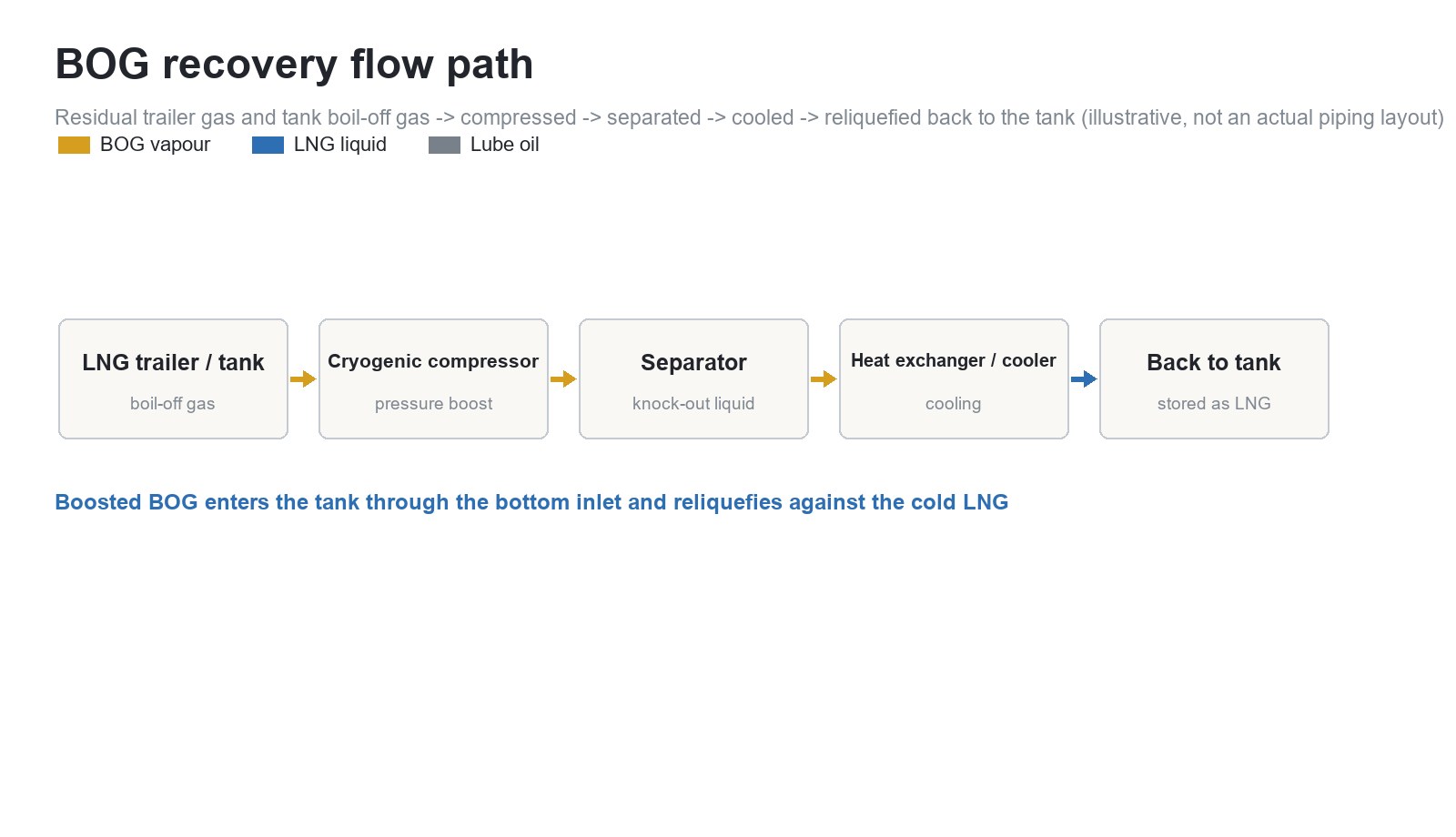
BOG recovery flow path (illustrative, not an actual piping layout)
The path is straightforward. After the trailer has finished unloading, the residual low-pressure BOG runs through piping into a cryogenic compressor, is boosted in pressure, and enters the LNG tank through the bottom liquid inlet. There it contacts the cold liquid and is reliquefied by the subcooling of the liquid, returning to the tank as LNG.
The operational point matters just as much. Once the recovery system is connected, unloading no longer has to be disturbed to hold tank pressure: liquid can be added while unloading continues, and the station does not have to stop at the end of unloading to balance the trailer or bring the tank pressure down. Unloading efficiency and delivery difference are saved right here.
3. Field photos: a natural-gas company station
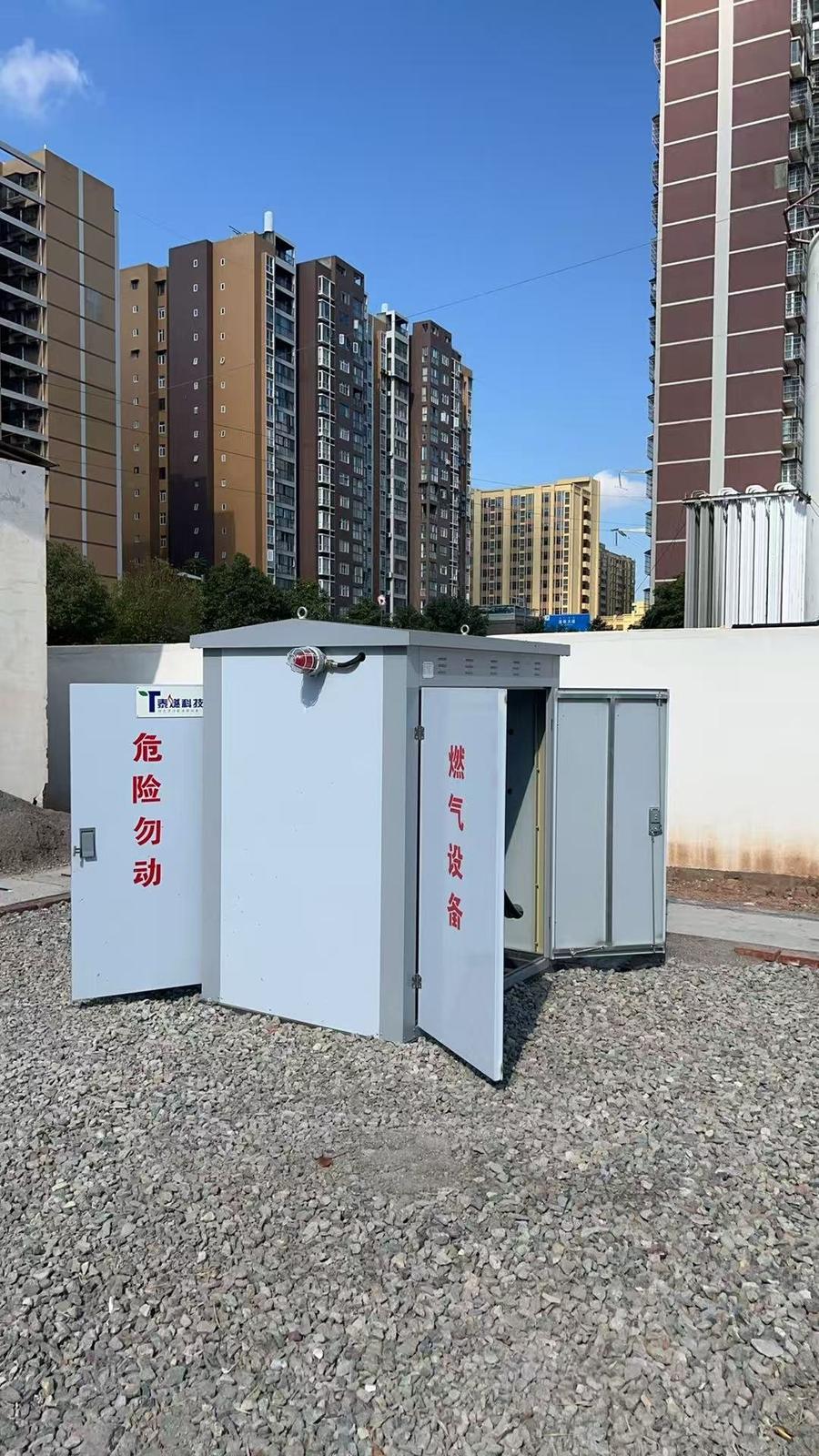
Enclosure exterior: doors marked "Do not touch / Gas equipment", audible-visual alarm on top (photo)
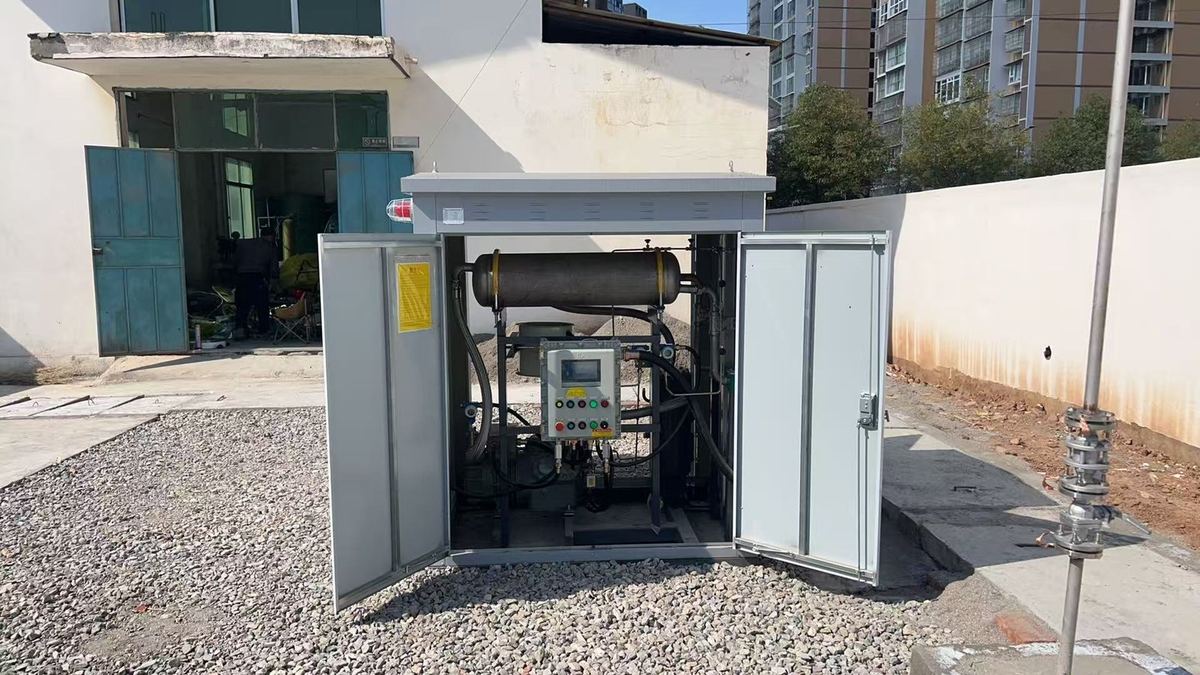
Doors open: buffer vessel, cryogenic compressor, explosion-proof control box and pipework (photo)
The whole unit is built as a packaged enclosure: rain and sun protection, noise insulation, liftable as one piece. On site it only needs the inlet and outlet piping and power connection before commissioning. The doors carry "Do not touch / Gas equipment", and an audible-visual alarm sits on the roof — what gas equipment should have, not decoration.
4. How to size the unit: six parameters, none optional
Check these six parameters first:
- Inlet pressure range: BOG pressure is low and fluctuates. Capacity must be verified at the minimum inlet pressure; otherwise the unit cannot pull the gas once tank pressure drops.
- Outlet pressure: back to tank, back to trailer or to network — this decides the number of stages and the power.
- Gas capacity: size to peak flow with margin, not to the daily average.
- Medium and temperature: low-temperature gaseous natural gas; materials, seals and lubricant must be chosen for cryogenic service. Water content must be accounted for — freezing or hydrate formation in the low-temperature section follows the same mechanism as icing in a CNG letdown skid.
- Safety configuration: gas leak detector, audible-visual alarm, explosion-proof fan, overpressure protection, pressure and temperature transmitters; missing any one fails acceptance.
- Packaging and foundation: one-piece enclosure; even on gravel ground a concrete foundation is required — do not set it directly on bare ground.
Actual parameters of this model (BOG-200):
| Item | Parameter |
|---|---|
| Medium | Natural gas (low-temperature, gaseous) |
| Operating temperature | −40 °C to 50 °C |
| Inlet pressure | 0.2–1.0 MPa |
| Outlet pressure | 1.6 MPa |
| Gas capacity | 50–200 Nm³/h |
| Installed power | 25 kW (cryogenic compressor 22 kW) |
| Power supply | 380 V / 50 Hz |
| Dimensions (enclosure) | 1600 × 1200 × 2100 mm |
| Inlet / outlet connection | DN50, PN25 |
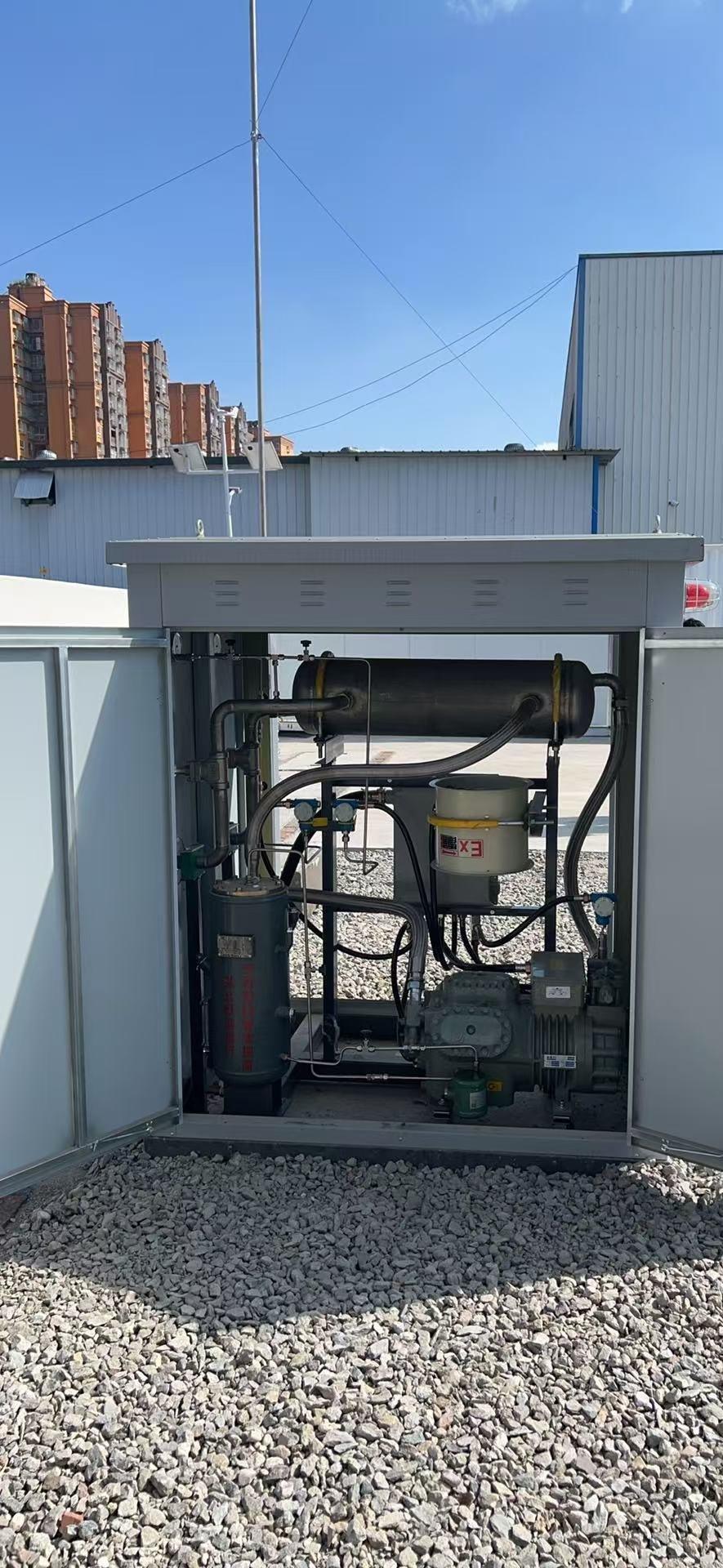
Interior overview: cryogenic compressor, separator, instruments and valve train (photo)
Main internal components: cryogenic compressor, two high-pressure heat exchangers, oil seal, oil-gas cooling drum, cryogenic shut-off and check valves, shock-resistant pressure gauges, explosion-proof distribution box, display, control system, gas leak probe, audible-visual alarm, explosion-proof fan, temperature and pressure transmitters, flexible metal hoses, base and piping fittings.
5. The payback: four numbers decide whether it is worth it
The formulas are simple:
Annual recovered value ≈ BOG flow (Nm³/h) × operating hours per year × gas price (yuan/Nm³)
Annual operating cost ≈ installed power (kW) × operating hours per year × electricity price (yuan/kWh) + maintenance
Net annual benefit = recovered value − operating cost
Take a hypothetical example (not a measured project): a station averages 60 Nm³/h BOG, runs 3,000 hours a year, gas price 3.5 yuan/Nm³, giving an annual recovered value of about 630,000 yuan; installed power 25 kW, annual electricity at 0.7 yuan/kWh about 53,000 yuan; after maintenance, net benefit above 500,000 yuan. Note: this is a worked example from assumed parameters, not a commitment for any specific project. Your project must be recalculated with measured gas volume and local gas and electricity prices.
Rule of thumb: payback within three years — go ahead; three to five years — depends on gas price trend and environmental requirements; beyond five years — start with a small modification, such as recovering only during unloading windows, rather than installing a large unit at once.
6. Which stations benefit most
- LNG refuelling stations unloading three or more trailers a day: large residual unloading gas, recovery is most direct.
- Vaporisation stations with a tank and low offtake: heat-ingress BOG persists long-term; recovery holds tank pressure down.
- Peak-shaving stations and reserve depots: BOG must be boosted before going into the network or high-pressure storage, turning it into a resource.
- Satellite supply stations and industrial onsite stations: strong unattended-operation requirement; choose automatic start-stop and remote monitoring.
7. Three sizing traps that matter more than price
- Sizing to average gas flow only. The unloading peak lasts an hour or two; sized on the daily average, the unit cycles frequently in the field and its service life is cut.
- Ignoring water content. Freezing or hydrate formation in the low-temperature section starts blocking after three months in service, and is then mistaken for a quality problem.
- Manual start-stop only. Starting only when pressure builds up means running at peak duty most of the time. Use automatic start-stop with high/low pressure protection, and remote monitoring where possible.
8. Closing note
BOG recovery is not an environmental prestige project. It is an account that can be worked out: gas volume, gas price, electricity price and annual operating hours — multiply and divide these four numbers and the conclusion follows. Measure the volume first, then discuss the size; however fine the unit looks, without enough gas flow it is a display piece.
The company holds special-equipment manufacturing certification for gas pressure-regulating equipment and GC2 industrial-pipeline installation certification, and BOG recovery units are in service on multiple projects. If you have a station that is currently venting, send the daily trailer count, tank volume and local gas price; engineering will work out a recovery plan for your duty. For unit configuration and sizing, see BOG recovery unit (unloading champion); for the paired vaporisation and pressure-regulating package, see LNG vaporisation skid / station.
Written by the Tairan engineering team from project records and standard documents. Please cite the source when quoting.