
CNG Skid-Mounted Pressure Reduction: 12 Key Questions
Five parameters decide a CNG pressure-reducing skid: flow rate, inlet pressure, outlet pressure, gas temperature and load pattern. Fix them before you compare configuration or price — otherwise you are pricing different machines. Twelve questions cover selection, station configuration, inspection and acceptance, with a data sheet you can send straight to a supplier.
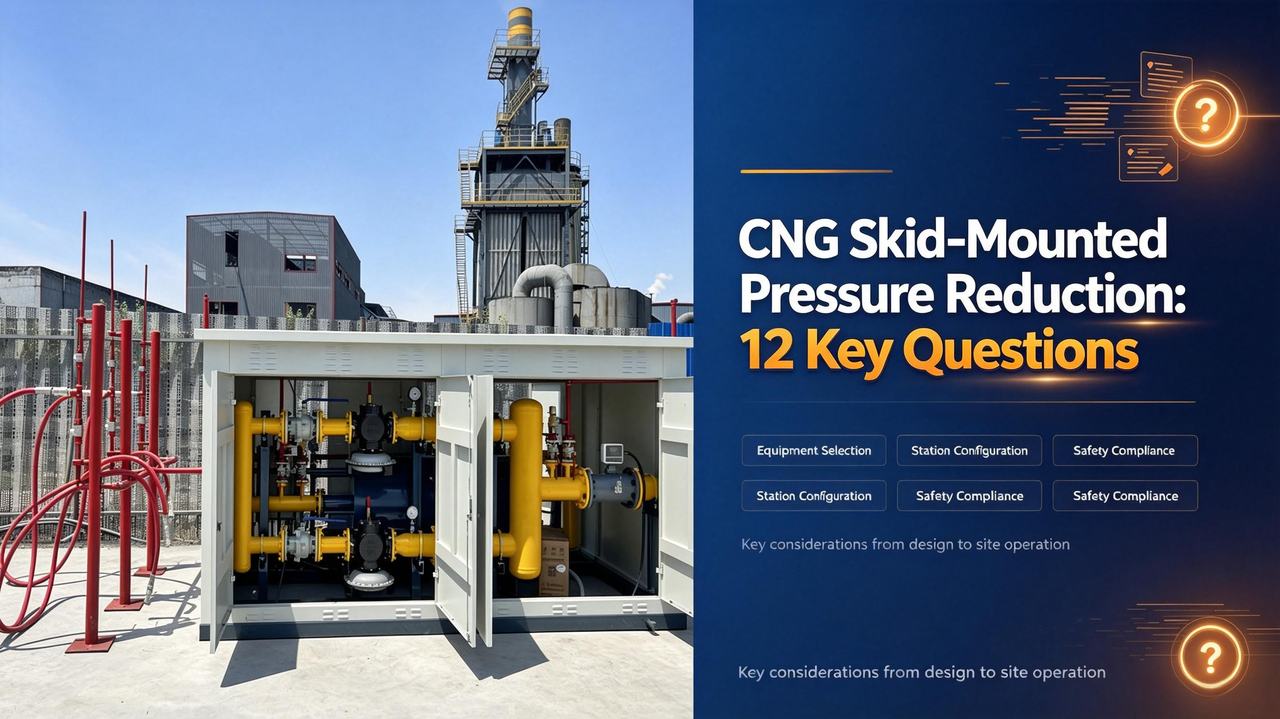
Who this is for: owners, EPC contractors and gas utility procurement teams preparing a CNG supply station, a point-of-use station or an industrial gas project. Every standard is cited by number; always check the version currently in force. Pressure, flow, lead time and price for a specific project are fixed against that project's design documents.
The short answer
Five parameters decide a CNG pressure-reducing skid: flow rate, inlet pressure, outlet pressure, gas temperature and load pattern. Fix these before you compare configuration or price. If the parameters are vague, you are not comparing the same machine.
1. What exactly is a CNG pressure-reducing skid, and what sits on it?
A CNG pressure-reducing skid — also called a CNG pressure regulating and metering skid, or PRMS — takes compressed natural gas from storage pressure down to the pressure the user needs, and handles metering, heating and safety protection in the same package. It is not a box: it is a set of equipment integrated on one skid frame.
| No. | Component | Function |
|---|---|---|
| 1 | Unloading post / inlet ball valve | Connects the CNG tube trailer or cylinder truck and unloads the gas |
| 2 | High-pressure filter | Traps particles from piping and cylinders, protects the regulator |
| 3 | First-stage reduction (regulator) | Drops 20 MPa class pressure to an intermediate level |
| 4 | Heat exchanger (water bath / electric) | Offsets the temperature drop of expansion, prevents hydrate freezing |
| 5 | Second / third-stage reduction | Takes intermediate pressure down to the use pressure |
| 6 | Metering | Turbine, Roots or ultrasonic meter with temperature and pressure compensation |
| 7 | Odorisation (optional) | Required when feeding a town gas distribution network |
| 8 | Safety system | Safety valves, shut-off valves, venting, overpressure protection |
| 9 | PLC cabinet | Pressure and temperature logging, alarms and interlocks, remote monitoring |
| 10 | Skid frame and base | Integration, weather protection, lifting and transport |
The usual trap: the quotation says "one skid" and nothing else. Only after signing do you learn that the filter, odoriser, remote transmission and standby branch all cost extra.
Our CNG skids ship with an itemised configuration list attached to the quotation — see CNG pressure-reducing skid for the working principle and selection notes.
2. The five parameters you must fix before design starts
This is the most important paragraph in the article. Without these five numbers, no quotation is comparable.
| Parameter | What it means | Typical value |
|---|---|---|
| Flow rate | Normal cubic metres per hour (Nm³/h) or actual cubic metres? Peak or average? | Must cover maximum, minimum and normal case |
| Inlet pressure | Working pressure of the cylinder trucks; whether trailers are switched on line | 20 MPa class; skid design pressure often 25 MPa |
| Outlet pressure | Town distribution network or direct industrial supply | 0.2–0.4 MPa for town medium-pressure networks |
| Gas temperature | Local extreme minimum, whether heat tracing is needed | Decides heat exchanger type and duty |
| Load pattern | Continuous, intermittent, or shutdowns allowed | Decides whether a standby branch is needed |
Three more that are often missed:
- Gas quality: sulphur content, water dew point, impurities. Sour or wet gas shortens regulator and seal life.
- Site conditions: fire separation distances, hazardous area classification, indoor or outdoor installation.
- Metering purpose: fiscal settlement or internal accounting. Fiscal metering carries different accuracy and calibration requirements.
The usual trap: the customer says only "I need 500 cubic metres" — no unit, no peak factor. The skid ends up undersized and pressure sags the first cold week of winter.
3. What inlet pressure should the skid be designed for?
CNG tube trailers and cylinder trucks work at around 20 MPa. Skid design pressure is normally set above working pressure — commonly 25 MPa or 27.5 MPa, fixed by the design documents and strength calculation.
For fixed storage at a station the limits are set elsewhere. GB 50156-2021, Technical standard for motor gasoline, CNG, LNG, LPG and hydrogen refuelling stations, clause 8.1.13: the maximum working pressure of fixed storage shall not exceed 40 MPa and shall not exceed the rated working pressure of the corresponding filling equipment by 5 MPa or more.
Note this: higher design pressure is not automatically better. Raise the class and wall thickness, flange rating, valve rating and inspection requirements all rise with it, and so does cost. A sensible class matched to the duty is cheaper than a blind upgrade.
4. How is outlet pressure set?
Outlet pressure is set by the downstream user, not by the skid.
- Town medium-pressure network: typically 0.2–0.4 MPa.
- Direct supply to kilns and boilers: per burner rated pressure, typically 0.05–0.4 MPa; some processes need more.
- CNG refuelling stations: part of the filling process; follow the filling requirements of GB 50156-2021.
The usual trap: outlet pressure set far above need and throttled down by the regulator. Running permanently at small opening causes hunting, noise and fast seat wear. Set the outlet as close to actual demand as possible.
5. How should flow rate be calculated?
Three things must be clear at once:
- Unit: Nm³/h (normal conditions) or m³/h (actual conditions). One compressibility factor apart — get it wrong and the number is off by an order of magnitude.
- Cases: maximum hourly, normal and minimum flow. A reducing skid has a limited turndown; sizing only on the maximum makes low-flow control unstable.
- Diversity factor: several draw-off points do not simply add up.
How to tell: if the other side asks only "how many cubic metres do you need" without unit or load cases, they are quoting, not selecting.
6. Why must the gas be heated after reduction?
Expanding natural gas from 20 MPa to 0.3 MPa drops its temperature sharply (the Joule-Thomson effect). Two consequences:
- Frost and ice on pipework and equipment exteriors;
- Regulator seats and seals failing at low temperature, or hydrate blockage.
So skids with a large pressure drop put a heat exchanger after the first stage — electric water bath or hot water circulation — bringing the gas temperature back up before the next stage.
The usual trap: cutting the heat exchanger to save money, then trouble every winter. In cold regions and on continuous-supply projects it is not an option.
7. Two stages or three?
It depends on the total drop and the outlet pressure required.
- Two stages: 20 MPa class → intermediate → use pressure. Suited to moderate drop and steady flow.
- Three stages: one more transition, smaller drop per stage, less seat erosion, lower noise, longer life. Suited to large drop, high flow and continuous operation.
The rule: the larger the single-stage drop, the worse the erosion and noise. Three stages on a very large drop is not upselling — it is how the core components last.
8. How should metering be specified?
Two cases:
- Internal accounting / process metering: relaxed accuracy, a standard meter is enough.
- Fiscal settlement: temperature and pressure compensation is mandatory, settlement in normal conditions, and the meter must be calibrated under metrology regulations.
Common types: turbine meters (small and medium flow, high accuracy), Roots meters (small and medium flow, wide range), ultrasonic meters (large flow, low pressure loss).
The usual trap: a meter without temperature and pressure compensation. Readings drift with pressure and temperature, and neither party accepts the bill.
9. Is odorisation really needed?
Projects feeding a town gas network need odorisation under town gas regulations so leaks are detectable. For direct industrial supply or in-plant use, whether to odorise follows the project design and local gas authority requirements.
Advice: write it into the configuration list at concept stage. Retrofitting later means positions, power supply and chemical storage — usually a change to the skid layout.
10. What inspections does the skid go through, and what documents come with it?
Manufacturing: pressure vessels and pressure piping components on the skid fall under special equipment regulation. The manufacturer must hold the corresponding licence, and the product must be welded, non-destructively tested, pressure (strength) tested and leak tested to code.
NDT: per the design documents and the NB/T 47013 series, Non-destructive testing of pressure equipment; radiography (RT) and penetrant testing (PT) are common, with acceptance levels set by the design.
Documents supplied at dispatch normally include:
| Document | What it proves |
|---|---|
| Certificate of conformity, nameplate, as-built drawings | The equipment's identity matches what was delivered |
| Material certificates | Pressure parts meet the design |
| Welding procedure and welder qualifications | Welding quality is controlled |
| NDT reports | Weld quality |
| Strength and leak test records | Pressure containment and sealing |
| Safety valve and gauge calibration reports | Safety accessories are valid |
| Operation and maintenance manual | Basis for operation after handover |
After commissioning: under TSG 21-2016, Supervision regulation on safety technology for stationary pressure vessels, clause 8.1.6.1, a metal pressure vessel generally receives its first periodic inspection within 3 years of commissioning. Later intervals are set by the inspection body according to the safety condition level — level 1 and 2 generally every 6 years, level 3 generally every 3 to 6 years, level 4 under monitored use. A vessel that fails inspection may not continue in service.
The conclusion: how long a unit lasts is not a promise from the maker. It is the accumulation of inspection records.
11. Why can quotations for the same CNG skid differ by a factor of two?
Four places — not brand premium.
- Wall thickness and material: the drawing says DN50 and a wall thickness; what actually arrived is what a caliper reads.
- Regulators and valves: imported versus copied parts can differ by tens of thousands per unit, and far more in life at low temperature and high pressure.
- Welding and testing: whether NDT is done, at what proportion, how long the pressure test holds, whether records are kept — all of it is cost.
- Service: walk away after installation, versus commissioning, training, inspection rounds and spare parts.
A test you can apply: on any quotation, look at three things — is the wall thickness stated, are the regulator and valve brands and models stated, are factory pressure test and NDT reports included. All three stated: worth a higher price. None stated: not worth a lower one.
12. Eight traps in purchasing and acceptance
- Comparing only the total price, not the configuration list.
- Flow unit unclear (normal versus actual cubic metres).
- Outlet pressure set too high, regulator running at small opening.
- Heat exchanger dropped in a cold region.
- Metering without temperature and pressure compensation.
- Odorisation, remote transmission, standby branch added only at acceptance.
- Incomplete dispatch documents, blocking commissioning and periodic inspection.
- Checking only that a manufacturing licence exists, not whether its scope covers the pressure class you are buying.
Appendix: selection data sheet (send this to any supplier)
| Item | To be filled in |
|---|---|
| Site / project name | |
| Load pattern (town network / industrial direct / other) | |
| Maximum hourly flow (Nm³/h) | |
| Normal flow (Nm³/h) | |
| Minimum flow (Nm³/h) | |
| Inlet pressure (MPa) | |
| Outlet pressure (MPa) | |
| Gas quality (sulphur, water dew point) | |
| Local extreme minimum temperature (°C) | |
| Continuous supply required? | |
| Standby branch required? | |
| Metering purpose (fiscal / internal) | |
| Odorisation required? | |
| Remote monitoring required? | |
| Site conditions (indoor / outdoor, hazardous area) |
Fill this in and send it over; we return an itemised configuration and a quotation against your duty — not a single lump-sum figure. Send your duty and selection request
Standards cited in this article
- TSG 21-2016, Supervision regulation on safety technology for stationary pressure vessels
- GB 50156-2021, Technical standard for motor gasoline, CNG, LNG, LPG and hydrogen refuelling stations
- NB/T 47013 series, Non-destructive testing of pressure equipment
Always check the version currently in force for the clauses above.
Written by the Tairan engineering team from project records and standard documents. Please cite the source when quoting.